
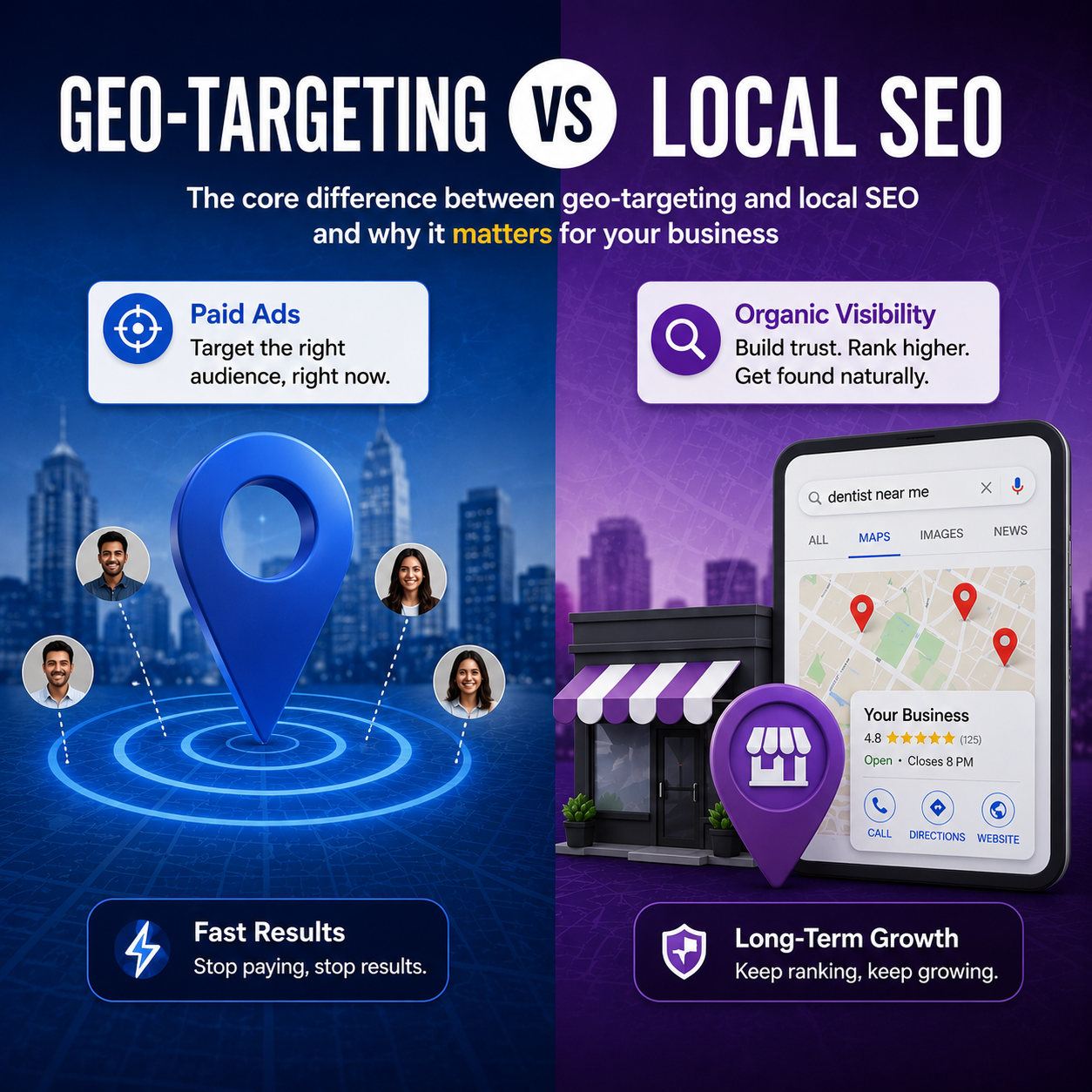
- The core difference between geo-targeting and local SEO and how each works
- Which strategy drives more conversions for Indian businesses and when to use each
- How to combine both approaches to get results from paid and organic channels
If you run a business in India and want to reach customers in specific cities or localities, you have likely heard about both geo-targeting and local SEO. Many marketing teams treat these as the same thing, but they work very differently and serve different stages of the buyer journey. Choosing the wrong one for the wrong goal costs you money and time.
Why Businesses Confuse These Two Strategies
Geo-targeting is a paid advertising feature that lets you show ads to users in a specific location. Local SEO is an organic strategy that helps your business appear in location-based search results without paying for each click. Both are location-focused, but that is where the similarity ends.
When a marketing manager says “we are doing local digital marketing,” they often mean only one of these two things. Running a Google Ads campaign targeted to Mumbai is not the same as ranking your Google Business Profile for searches in Mumbai. Mixing up the two leads to budget misallocation and missed growth opportunities.
Understand What Each Strategy Actually Does
What Geo-Targeting Does
Geo-targeting is a setting inside paid platforms like Google Ads, Meta Ads, and Programmatic networks. It restricts your ad delivery to users within a defined geographic area such as a city, PIN code, or radius around a location. You pay each time a user clicks or sees your ad, depending on your campaign type.
Geo-targeting works in real time. The moment someone in Bengaluru searches for “office chairs” and you are running a geo-targeted campaign for Bengaluru, your ad can appear instantly. It does not depend on your website’s authority or how long you have been in business.
What Local SEO Does
Local SEO is the process of improving your visibility in organic, location-based search results. This includes ranking in Google’s local pack (the map results), appearing in “near me” searches, and building consistent business information across directories. It takes time but does not require a per-click budget once established.
Local SEO depends on signals like your Google Business Profile completeness, local citations, customer reviews, and location-relevant content on your website. A strong local SEO presence builds trust because users know those results are earned, not purchased.
Break Down What Converts and Why
Conversion Behaviour in Geo-Targeted Ads
Geo-targeted ads convert well when the user already has purchase intent and your offer is specific and time-sensitive. A dental clinic in Pune running a geo-targeted ad for “teeth cleaning discount” to users within 5 km can drive same-day appointment bookings. The conversion speed is high because the ad reaches an active searcher at the right moment.
The risk is that conversion rates drop when targeting is too broad or the ad creative is generic. Paying for clicks from users in Hyderabad when your service only covers Secunderabad is a common and costly mistake. Precise radius and PIN code targeting reduces wasted spend significantly.
Conversion Behaviour in Local SEO
Local SEO converts well for users in the research and comparison phase. When someone searches “best CA firm in Chennai,” they are gathering options before making a decision. A well-optimised Google Business Profile with strong reviews and a clear service area can earn that click without any ad spend.
The conversion cycle through local SEO is often longer but the lead quality is frequently higher. Users who find you organically have already filtered through results and chosen to click on your listing. This self-selection process often means they are more serious buyers.
Cost Per Acquisition Comparison
Geo-targeted ads deliver faster results but carry an ongoing cost structure. Local SEO has a higher upfront time investment but reduces your cost per acquisition as rankings hold over time. Your industry, competition level, and city all affect which delivers better ROI for your specific situation.
| Factor | Geo-Targeting (Paid) | Local SEO (Organic) |
|---|---|---|
| Speed to results | Immediate (within hours) | Weeks to months |
| Cost structure | Pay per click or impression | Time and content investment upfront |
| Sustainability | Stops when budget stops | Continues earning traffic after initial work |
| Best for | Promotions, launches, time-sensitive offers | Long-term brand presence and trust building |
| User trust level | Lower (users know it is an ad) | Higher (earned position) |
| Control over audience | High (PIN code, radius, demographics) | Moderate (driven by search intent and location) |
| Scalability | Scale by increasing budget | Scale by expanding content and citations |
Consider a real estate developer in Navi Mumbai launching a new residential project. They run geo-targeted ads on Google and Meta to reach users in specific PIN codes showing interest in property. At the same time, their website ranks organically for “2BHK flats in Navi Mumbai” through local SEO work done over six months. The geo-targeted ads drive immediate site visits and enquiry form fills during the launch week. The local SEO presence continues to bring in leads three months after the ad budget is paused. Both channels contribute to conversions, but at different stages and at different costs.
At Adsterix Digital, the team works with Indian businesses to plan location-based marketing that balances immediate reach through paid targeting and long-term visibility through local SEO. Rather than pushing one channel over the other, the focus stays on what your business goals, budget cycle, and target geography actually require. If you want a clear plan for your city or service area, visit adsterixdigital.com to connect with the team.
Frequently Asked Questions
Is geo-targeting only for large businesses with big ad budgets?
No. Geo-targeting can work for businesses of any size because you control the daily budget and the targeting radius. A small salon in Koramangala can run a geo-targeted campaign within a 3 km radius with a modest daily budget and still reach relevant local customers. The key is tight targeting and a clear offer, not a large spend.
How long does local SEO take to show results for an Indian business?
Most businesses start seeing measurable improvements in local rankings within three to six months, depending on competition in their city and the consistency of their optimisation work. A business in a smaller city like Nagpur may rank faster than one competing in a saturated market like Delhi or Mumbai. Regular review management, profile updates, and local content accelerate the process.
Can a business run geo-targeting and local SEO at the same time?
Yes, and running both together is often the most effective approach. Geo-targeting covers you immediately while local SEO builds your organic presence over time. Many Indian businesses use paid geo-targeting during product launches or seasonal campaigns and rely on local SEO to maintain visibility and reduce long-term marketing costs.
Which strategy works better for service-area businesses in India?
Service-area businesses such as plumbers, electricians, and home cleaners benefit strongly from local SEO because Google allows them to set a service area without a physical storefront. Geo-targeted ads also work well for these businesses when they want to push a specific offer or fill appointment slots quickly. Combining both gives service-area businesses consistent visibility across paid and organic channels.
What is the single most important factor for local SEO in India?
A complete and regularly updated Google Business Profile is the most important starting point for local SEO in India. Your profile must have accurate business categories, service areas, hours, photos, and a steady flow of genuine customer reviews. Without a strong Google Business Profile, even well-optimised website content will struggle to rank in local pack results.